Viruses in space evolved and learned to kill bacteria more effectively
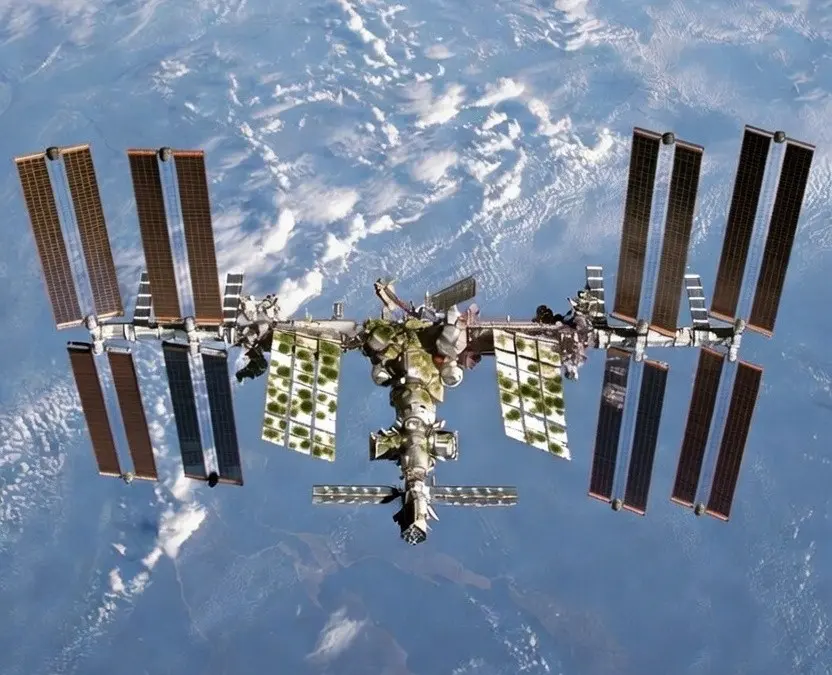
The International Space Station (ISS) is a unique laboratory where life behaves unpredictably. New research conducted in orbit has revealed the surprising behavior of bacteriophages — viruses that attack bacteria. In microgravity conditions, their interaction with bacteria takes on a new and unexpected dimension.
Unexpected evolution
A group of scientists led by Srivatsan Raman, from the University of Wisconsin-Madison, studied how bacteriophage T7 infects Escherichia coli bacteria aboard the ISS and compared the process with a similar one on Earth. In orbit, due to the peculiarities of liquid mixing in microgravity, the phages initially attacked more slowly. However, both bacteria and viruses quickly mutated, adapting to the new conditions. The main conclusion: microgravity not only slows down processes, but also changes the course of evolution itself.
“We observed mutations appearing in unexpected genes,” Raman explained. The bacteria developed additional defenses, and the phages evolved to infect them more effectively. Their genetic changes differed from those recorded in terrestrial laboratories.
These discoveries are critical for long interplanetary flights, such as to Mars. Microorganisms on board are not passive “passengers.” They can evolve in unpredictable ways, which can affect the health of the crew and the operation of life support systems.
A new era in space biology
The most interesting thing is that the “space” mutations of phages prove to be useful on Earth. Phages that evolved on the ISS are more effective against strains of E. coli that are resistant to the usual T7 phage and cause urinary tract infections in humans. This opens up new possibilities for phage therapy — treating antibiotic-resistant infections with viruses.
A study published in PLOS Biology proves that space is not just a place to repeat Earth-based experiments. It is a fundamentally different environment capable of revealing new biological mechanisms. Understanding the evolution of microbes in zero gravity could lead to revolutionary discoveries in both space medicine and the fight against dangerous infections on our planet.
Earlier, we reported on how E. coli and salmonella accompanied the astronauts of the Crew-11 mission.
According to Live Science
Posted in News, ScienceTaggedbacteries,experiments,ISS
https://www.facebook.com/v21.0/plugins/comments.php?app_id=810419964291236&channel=https%3A%2F%2Fstaticxx.facebook.com%2Fx%2Fconnect%2Fxd_arbiter%2F%3Fversion%3D46%23cb%3Dfc7397b98a87bf249%26domain%3Duniversemagazine.com%26is_canvas%3Dfalse%26origin%3Dhttps%253A%252F%252Funiversemagazine.com%252Fff6e48a48b697fa19%26relation%3Dparent.parent&container_width=804&height=100&href=https%3A%2F%2Funiversemagazine.com%2Fen%2Fviruses-in-space-evolved-and-learned-to-kill-bacteria-more-effectively&locale=en_US&numposts=5&order_by=social&sdk=joey&version=v21.0&width=

science communicator, author
Part of the Universe Space Tech team since 2017. Focuses on interplanetary missions, the history of space exploration, rocket launches, and scientific discoveries in both near and deep space. Over the years, he has written dozens of materials — from fact-checked news to deep-dive analyses. His fascination with space began in childhood and eventually became his professional direction. He joined Universe Space Tech to tell readers about modern space events in a clear and engaging way. His writing combines accuracy, structure, and deep respect for scientific knowledge.